
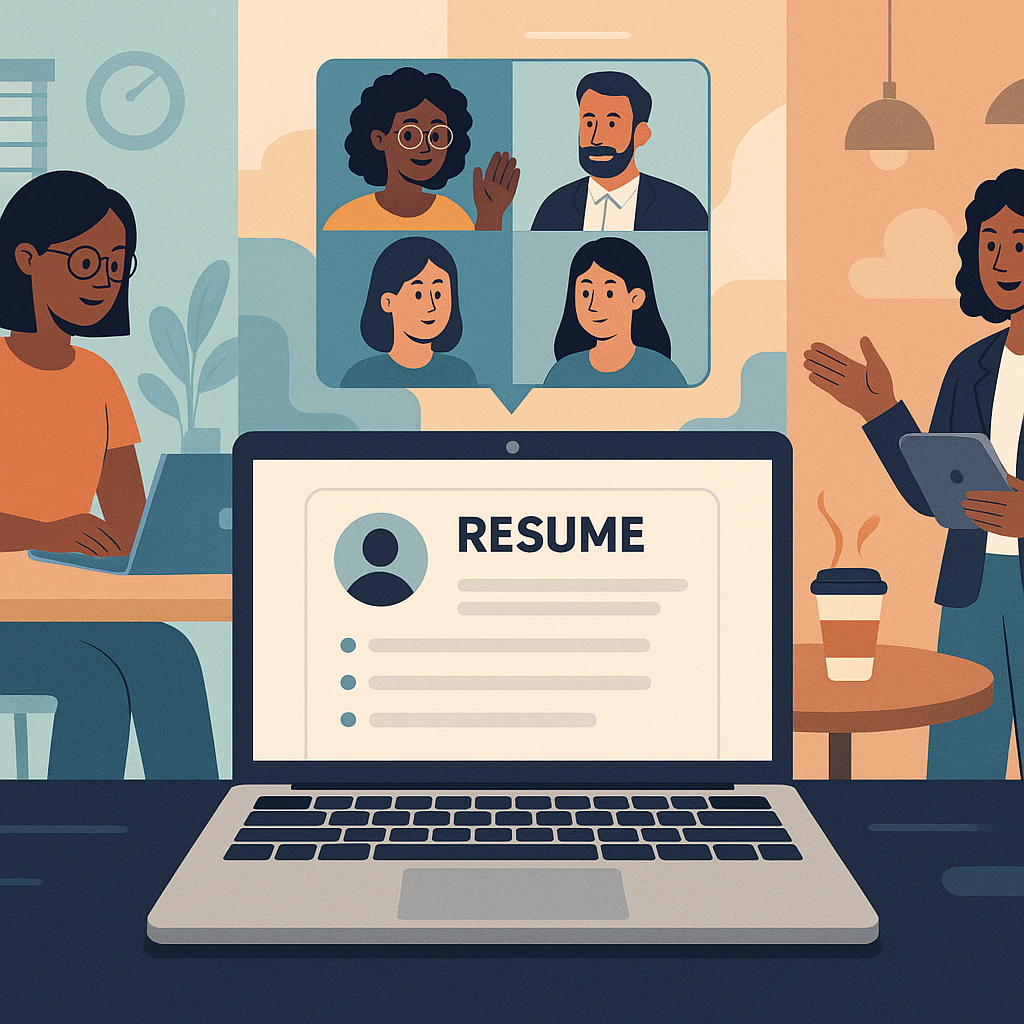
Hybrid Work Resume: A Comprehensive Guide to Crafting Resumes for Distributed Teams
Learn how to create a hybrid work resume that stands out. Showcase remote collaboration skills, async communication, and measurable outcomes for distributed teams.
Hybrid Work Resume: How to Build a Distributed Team Resume That Stands Out
Estimated reading time: 15 minutes
Key Takeaways
- A hybrid work resume highlights your ability to excel in mixed remote and in-office environments by emphasizing remote collaboration and asynchronous communication skills.
- Clearly demonstrating measurable outcomes and tool proficiency significantly improves your chances in distributed team hiring.
- Tailoring resumes to align with company culture and tooling stacks ensures relevance and resonance with hiring managers.
- Strong hybrid resumes balance ATS-readability with engaging, quantifiable storytelling to make a lasting impression.
Table of Contents
Introduction — Hybrid Work Resume & Distributed Team Resume
A hybrid work resume is a targeted resume designed to win roles where work happens across a mix of in-office and remote settings. It emphasizes your ability to collaborate virtually, communicate asynchronously, and produce results across time zones and tools. Because hiring for distributed teams has accelerated, employers now scan resumes for proof that you can thrive in hybrid, remote-first, and globally distributed team environments.
Why this matters: organizations are optimizing for productivity, flexibility, and access to talent. That means they rely on candidates who demonstrate remote collaboration skills, self-management, and proficiency with digital work systems. An effective hybrid work resume (sometimes called a distributed team resume) signals to hiring managers that you can handle virtual workflows, navigate ambiguity, and still deliver measurable outcomes.
Below is a detailed, step-by-step blueprint to create a hybrid work resume that is clear, quantifiable, and tailored for distributed teams—without fluff, and with examples you can adapt right away.
Understanding Hybrid Work Environments — Distributed Team Resume
Hybrid work is a model where employees split time between office and remote locations. A distributed team extends this concept: teammates may be fully remote, co-located in hubs, or spread across countries. Your distributed team resume should show you understand the practical realities of this environment.
Key characteristics of hybrid and distributed teams:
- Location diversity
- Hybrid: some in-office presence paired with remote days.
- Distributed: team members across cities, countries, or time zones (fully remote or hub-and-spoke).
- Schedule flexibility
- Hybrid: scheduled office days plus flexible remote hours.
- Distributed: overlapping hours are limited; heavy reliance on asynchronous communication.
- Communication patterns
- Hybrid: mix of face-to-face meetings and virtual standups.
- Distributed: async-first, documented decisions, recorded demos, clear updates.
- Tool reliance
- Hybrid: chat, video, project management tooling augment in-person collaboration.
- Distributed: collaboration platforms are the backbone—chat threads, video calls, shared docs, wikis, and kanban boards.
How work dynamics change in a distributed team:
- Communication challenges
- Fewer real-time conversations; misalignment risks increase without structured updates.
- Greater need for clarity in written communication (briefs, RFCs, task tickets).
- Increased reliance on technology
- Chat (Slack, Microsoft Teams), video (Zoom, Meet), kanban (Trello, Jira), documentation (Confluence, Notion), inheritboarding (Miro), cloud storage, and workflow automation.
- Emphasis on adaptability
- Shifting priorities, asynchronous handoffs, and self-serve documentation.
- Ability to move between synchronous ceremonies (daily standups, sprint reviews) and asynchronous workflows (status updates, code reviews, decision logs).
- Outcome orientation
- Managers value measurable impact and reliable delivery over visible busyness.
- Your hybrid work resume should highlight results, autonomy, and process discipline.
Bottom line: a strong hybrid work resume demonstrates you can operate smoothly in a distributed setup—communicating clearly, documenting decisions, and collaborating across tools and time zones.
Essential Elements of a Hybrid Work Resume — Hybrid Work Resume & Remote Collaboration Skills
Before content, get the structure right. An ATS-friendly, human-readable hybrid work resume typically includes:
- Contact information
Name, city and state (or country if applying globally), professional title (e.g., Product Manager | Hybrid & Remote Collaboration), email, phone, optionally a portfolio or Git repository if relevant.
Include your time zone if applying to global roles. - Summary (3–4 lines)
A concise professional pitch that mentions hybrid work resume strengths: remote collaboration skills, distributed team experience, and relevant domain expertise.
Include role-aligned keywords (e.g., Agile delivery, cross-functional leadership, asynchronous communication, virtual stakeholder management). - Core skills (9–15 bullet points, grouped)
- Collaboration and communication: async-first writing, stakeholder alignment, facilitation.
- Technical/tooling: Slack/Teams, Zoom/Meet, Miro, Notion/Confluence, Jira/Trello, Google Workspace/Microsoft 365, project tracking, documentation.
- Remote work enablers: time management, prioritization, autonomy, digital etiquette, cultural sensitivity.
- Professional experience (reverse chronological)
Company, role, location (Remote/Hybrid), dates.
4–6 bullets per role focused on outcomes, metrics, scale, and context.
Include distributed team scenarios: cross-time-zone projects, async deliverables, virtual leadership. - Education and certifications
Degrees, credible certifications (Agile/Scrum, project management, product, security or compliance as relevant). - Optional sections
Selected projects (remote-led initiatives), publications or talks (virtual conferences, webinars), volunteer work (online communities), awards (team collaboration, remote innovation).
Languages (useful for global collaboration), tools proficiency (with proficiency levels), and professional affiliations.
Positioning tip: In each section, reinforce remote collaboration skills with verbs and quantifiable results. Recruiters need immediate signals that you deliver, not just participate.
Highlighting Remote Collaboration Skills — Remote Collaboration Skills & Hybrid Work Resume
Remote collaboration skills differentiate average hybrid resumes from compelling ones. Showcase both the soft and technical dimensions:
Core remote collaboration skills to feature:
- Communication and documentation
- Clear, concise async writing: status updates, briefs, decision logs, meeting notes.
- Video call facilitation: agendas, time-boxing, participation management, action items.
- Presentation fluency: screen-sharing, virtual demos, recorded walkthroughs.
- Tool proficiency
- Chat/messaging: Slack, Microsoft Teams.
- Video conferencing: Zoom, Google Meet.
- Project and task management: Jira, Trello, Asana, Monday.com, Azure Boards.
- Documentation and knowledge bases: Confluence, Notion, Google Docs, Microsoft OneNote/SharePoint.
- Whiteboarding and design collaboration: Miro, Figma.
- Time management and self-direction
- Prioritization, focus blocks, sprint planning, blocking/unblocking.
- Outcome orientation: ship increments, meet SLAs, hit OKRs/KPIs.
- Cultural intelligence and inclusivity
- Awareness of time zones, holidays, communication styles; inclusive facilitation.
- Empathy in feedback, clarity in tone, mindful of language barriers.
- Flexibility and adaptability
- Switching between synchronous and asynchronous modes.
- Learning new tools and processes quickly; resilience under uncertainty.
- Digital etiquette and security
- Clean documentation, clear naming conventions, version control for docs.
- Privacy and compliance awareness when sharing screens or data.
Examples to showcase remote collaboration skills on a hybrid work resume:
- “Led a cross-time-zone product squad (UTC-8 to UTC+5:30), shipping a critical feature that increased self-serve conversions by 18% in one quarter.”
- “Facilitated weekly async status reports and decision records, cutting meeting time by 35% while improving delivery predictability (on-time releases from 72% to 93%).”
- “Standardized Jira workflows and dashboards for three teams, reducing cycle time by 22% and improving backlog visibility for stakeholders.”
- “Introduced Miro retrospectives and Notion playbooks; ramp time for new hires dropped from 6 weeks to 4 weeks.”
- “Chaired virtual incident response drills; mean time to recovery (MTTR) decreased from 3.2 hours to 1.8 hours over two quarters.”
- “Mentored 4 remote analysts via weekly 1:1s and async code reviews; boosted team PR merge velocity by 27%.”
- “Coordinated remote discovery with 12 enterprise clients; prioritized features yielding a 15% uplift in net revenue retention.”
Quantification framework for hybrid work resume bullets:
- Action verb + context (remote/distributed) + tool/process + measurable result
- “Orchestrated a distributed UAT across 4 regions using Zoom and shared test plans; reduced defect leakage by 40% pre-release.”
- “Authored async onboarding guides in Confluence; cut support escalations by 25% within 60 days.”
Tailoring Your Resume for Distributed Teams — Distributed Team Resume & Remote Collaboration Skills
Customization wins interviews. Align your distributed team resume to each company’s culture and collaboration style.
How to research and align:
- Decode culture from job descriptions
Look for keywords: remote-first, async culture, documentation-driven, flexible hours, outcome-based, Agile, scrum-of-scrums.
Map these to your own experiences and mirror phrasing naturally. - Analyze the collaboration stack
Many teams specify preferred tools (e.g., Slack, Jira, Zoom, Confluence). Elevate matching tools prominently in your skills and experience bullets. - Identify values and behaviors
If a company emphasizes ownership, autonomy, and written communication, foreground project ownership, RFCs, and decision-making artifacts you led. - Calibrate seniority signals
For IC roles: emphasize individual delivery, craft, and peer collaboration.
For leadership roles: emphasize virtual facilitation, coaching, governance, cross-functional alignment, and outcome accountability.
Phrases and keywords that resonate with remote work and collaboration:
- Cross-functional team leadership
- Remote project management
- Async-first communication
- Distributed stakeholder alignment
- Virtual facilitation and workshops
- Documentation-driven development
- Outcome-focused delivery (OKRs/KPIs)
- Time-zone-aware coordination
- Continuous delivery in remote squads
- Knowledge base curation and playbooks
- Remote onboarding and enablement
Where to place these:
- Summary
“Remote-first product manager with 7+ years leading distributed teams to deliver B2B SaaS outcomes; expert in async collaboration, Jira/Confluence, and stakeholder alignment across time zones.” - Skills
Group by competency: “Async writing,” “Virtual facilitation,” “Tooling: Slack, Zoom, Jira, Notion,” “Agile/Lean,” “Data-informed decision-making.” - Experience bullets
Blend context and results: “Piloted async sprint rituals; velocity rose 19% while meetings declined by 28%.”
Design Considerations for a Hybrid Work Resume — Hybrid Work Resume
Your hybrid work resume must be scannable on screens, parsable by ATS, and pleasant for human readers.
Formatting principles:
- Layout
Single column, clean margins (0.5–1.0 inches), generous inherit space.
Use bullet points, not dense paragraphs; 1–2 lines per bullet. - Typography
Readable sans-serif or serif fonts; consistent sizing (11–12 pt body, 13–14 pt headings).
Avoid text boxes, tables, and graphics that may confuse parsing. - Section hierarchy
Clear headings: Summary, Skills, Experience, Education, Certifications, Projects.
Keep section titles consistent and optimized for ATS. - File and delivery
Save as PDF for human readability (preserve formatting); keep a plain-text or .docx ATS-friendly version ready if requested.
File name convention: FirstLast_Role_HybridResume.pdf - Emphasis techniques
Use bold sparingly for company names, roles, and key metrics (e.g., “+32% NPS”).
Avoid italics/underlines for long passages; maintain clarity on screens. - Length
1 page for early career; up to 2 pages for 7–10+ years or complex roles. Ensure every line earns its place. - Accessibility and clarity
Use meaningful headings and avoid excessive abbreviations.
Spell out less-common acronyms once; maintain inclusive, bias-aware language.
ATS and keyword optimization:
- Match job description terminology (e.g., “remote project management,” “distributed team leadership,” “asynchronous communication”).
- Repeat priority keywords in Summary, Skills, and Experience where natural.
- Avoid graphics, columns, headers/footers with critical info (ATS may not parse them).
Common Mistakes to Avoid — Hybrid Work Resume & Remote Collaboration Skills
Avoid pitfalls that dilute credibility or hide your strengths in remote contexts.
Frequent errors:
- Vague responsibilities
Saying “managed projects” without scope, tools, or outcomes. Fix: “Managed a remote product launch across 3 squads using Jira/Confluence; achieved 96% on-time delivery.” - No remote context
Not stating “Remote,” “Hybrid,” or distributed aspects of roles. Fix: explicitly label location model and time-zone breadth. - Tool name-dropping without results
Listing Slack/Zoom/etc. without impact. Fix: pair tools with improvements (e.g., “Slack workflow automation cut triage time by 45%”). - Over-indexing on duties vs. outcomes
Duties are interchangeable; outcomes differentiate. Fix: quantify impact—revenue, NPS, cycle time, cost, quality, risk. - Wall-of-text bullets
Dense language hampers skimming. Fix: 1–2 lines per bullet, lead with action verbs, place metrics near the start. - Ignoring asynchronous collaboration
Overemphasis on meetings; underemphasis on documentation. Fix: demonstrate decision logs, playbooks, and async updates. - Inconsistent terminology
Mixing “project,” “program,” “product” imprecisely. Fix: use disciplined labels that match the role family. - Omitting cross-cultural competence
Distributed teams need cultural fluency and inclusive facilitation. Fix: note inclusive practices and outcomes (participation rates, satisfaction scores).
How to upgrade a resume lacking remote collaboration skills:
- Audit and extract remote moments
Identify any virtual elements (online stakeholders, remote vendors, cloud tools) and make them explicit. - Reframe bullets with distributed context
Add time zones, virtual ceremonies, and tool stack. - Add quantification
Tie actions to lead/lag metrics (cycle time, throughput, CSAT, MTTR, ARR influenced, churn reduction). - Solicit feedback
Ask peers and managers to validate outcomes; refine wording to reflect actual impact. - Showcase learning
Include relevant certifications or coursework focused on virtual teamwork, Agile facilitation, documentation, or data-informed decision-making. - Clean up design
Make it skimmable: stronger headings, tighter bullets, consistent tense and format.
Examples of Strong Hybrid Work Resumes — Distributed Team Resume & Hybrid Work Resume
Example 1: Product Manager (Remote-First SaaS)
Summary
Remote-first product manager with 8+ years delivering B2B SaaS outcomes in distributed teams (UTC-8 to UTC+2). Expert in async collaboration, customer discovery, and Jira/Confluence-driven execution; shipped features raising expansion revenue by 22%.
Core Skills
- Remote collaboration: async briefs, virtual workshops, stakeholder alignment, RFCs.
- Tooling: Jira, Confluence, Slack, Zoom, Miro, Amplitude, Notion.
- Delivery: Agile/Scrum, OKRs, product discovery, A/B testing, backlog prioritization.
Experience
- Senior Product Manager, Hybrid (Remote 80%)
- Orchestrated a cross-region launch with 3 distributed squads using Jira/Confluence; on-time delivery improved from 78% to 96% in 2 quarters.
- Ran async customer discovery using recorded Zoom interviews; identified friction points that increased self-serve conversion by 18%.
- Standardized Miro-based retros and Notion playbooks; new-PM ramp time dropped from 8 to 5 weeks.
- Instituted weekly async product updates; executive decision latency decreased by 40%. - Product Manager, Remote
- Led virtual beta with 50 customers; feature set refined, driving +12 net NPS lift post-launch.
- Built KPI dashboards boosting visibility for remote stakeholders; cut unplanned work by 21%.
Why this works
- Immediate hybrid context (remote-first, time zones).
- Tight linkage between collaboration practices and business metrics.
- Tool names appear with concrete impact, not as a laundry list.
Example 2: Engineering Lead (Distributed Platform Team)
Summary
Engineering lead experienced in distributed platform delivery across 6 time zones. Coaches remote engineers, facilitates async decision-making, and ships secure, reliable services (SLO-driven) using Slack, Jira, GitHub, and Zoom.
Core Skills
- Leadership: remote mentoring, virtual facilitation, incident command, roadmap alignment.
- Tooling: GitHub, Jira, Slack, Zoom, Confluence, Datadog, Terraform.
- Practices: trunk-based development, CI/CD, SRE principles, RFCs, blameless postmortems.
Experience
- Engineering Manager, Remote
- Mentored 7 remote engineers; PR review SLAs met 95%+; merge time dropped by 31%.
- Implemented async RFC workflow; architectural decisions documented; rework reduced 24%.
- Coordinated global on-call; MTTR decreased from 3.2h to 1.6h, SLO breach incidents fell 38%.
- Led Zoom-based chaos drills; service resilience improved (99.95% to 99.98%). - Senior Software Engineer, Hybrid
- Automated CI with GitHub Actions; deployment frequency increased 3x with zero rollback.
- Created Confluence runbooks; onboarding to on-call halved from 6 weeks to 3 weeks.
Why this works
- Highlights remote leadership and engineering outcomes.
- Blends SRE metrics with collaboration artifacts (RFCs, runbooks).
- Shows stepwise improvements attributable to distributed team practices.
Example 3: Marketing Manager (Global Campaigns, Hybrid)
Summary
Hybrid marketing manager specializing in remote campaign orchestration across EMEA and AMER. Skilled in async stakeholder management, content ops, and analytics-driven iteration using Trello, Slack, and Google Workspace.
Core Skills
- Collaboration: async briefs, editorial calendars, virtual standups, cross-functional alignment.
- Tooling: Trello, Slack, Zoom, Google Analytics, Data Studio, Notion, Miro.
- Channels: lifecycle email, SEO content ops, webinars, partner marketing.
Experience
- Marketing Manager, Hybrid
- Centralized campaign planning in Trello/Notion; reduced duplicate work by 42% across 3 regions.
- Facilitated virtual content reviews; production cycle time shrank from 21 to 12 days.
- Ran webinars with distributed speakers; lead-to-opportunity conversion rose by 14%.
- Implemented async feedback loops; improved content accuracy, cutting revisions by 30%. - Content Specialist, Remote
- Authored playbooks for remote SMEs; article throughput increased 2.3x with consistent quality.
- Standardized analytics dashboards; time-to-insight for non-technical stakeholders cut by 50%.
Why this works
- Cross-functional remote coordination is explicit and quantified.
- Tools connect directly to throughput, accuracy, and conversion improvements.
- Communicates mastery of async planning and stakeholder alignment.
Step-by-step breakdown of success signals across examples:
- Context tagging
Each role labeled Remote or Hybrid; time-zone spread noted where relevant. - Actionable verbs
Orchestrated, standardized, implemented, facilitated, mentored—paired with processes and tools. - Measurable outcomes
Percent improvements, time reductions, SLA/MTTR shifts, NPS/ARR/throughput lifts. - Async artifacts
RFCs, decision logs, runbooks, playbooks, dashboards—evidence of documentation-first habits. - Tool fluency
Tools appear as enablers of outcomes, not isolated skills. - Inclusion and culture
Mentoring, blameless postmortems, and global coordination demonstrate empathy and maturity in distributed settings.
Practical Bullet Templates for Your Hybrid Work Resume — Remote Collaboration Skills
Use and adapt these fill-in patterns to strengthen your bullets:
- Led a distributed [team/function] across [regions/time zones] using [tools]; achieved [metric] improvement in [timeframe].
- Implemented [process/practice] (async [briefs/RFCs/updates]); reduced [waste/time/defects] by [X%].
- Standardized [tool/workflow/dashboards] for [N] teams; increased [visibility/velocity] by [X%].
- Facilitated virtual [workshops/retros/demos]; improved [participation/decision speed] by [X%].
- Built [knowledge base/playbooks/runbooks]; cut [onboarding/escalations] by [X%].
- Coordinated remote [launch/beta/migration]; delivered [outcome] with [quality metric].
Optimization Tips by Role Type — Hybrid Work Resume
- Product and program management
Emphasize backlog health, delivery predictability, stakeholder satisfaction, OKR attainment, and roadmap transparency. - Engineering and data
Show code review SLAs, deployment frequency, lead time for changes, MTTR, test coverage, data pipeline reliability, and reproducibility. - Design and research
Highlight remote user research cadence, design system governance, async critiques, and iteration speed. - Sales and customer success
Demonstrate virtual pipeline management, remote discovery, account expansion, NPS/CSAT improvements, and churn reduction. - Operations and HR/People
Showcase remote onboarding, policy rollouts, engagement metrics, process SLAs, and automation of repetitive tasks. - Marketing and content
Quantify campaign ROI, content throughput, conversion increases, webinar attendance-to-MQL conversion, and localization efficiency.
Proofreading and Quality Gates — Distributed Team Resume
Before submitting your distributed team resume, run these checks:
- Signal check
Are “Remote” or “Hybrid” clearly labeled for each role?
Are remote collaboration skills visible above the fold (Summary/Skills)? - Metric density
At least 70% of bullets should contain measurable outcomes. - Tool-to-impact linkage
Where you mention a tool, is the outcome clear? - Language and tone
Concise, active voice, role-aligned keywords, region-sensitive spelling if applying globally. - Consistency
Dates, tense (past for previous roles, present for current), punctuation, capitalization. - ATS readiness
Simple structure, no images or complex tables, standard section headings.
Conclusion — Hybrid Work Resume
A well-crafted hybrid work resume materially improves your odds in today’s market. Employers need people who deliver results in hybrid and remote-first settings—people who document decisions, communicate asynchronously, and align distributed stakeholders. By foregrounding remote collaboration skills, quantifying your impact, and tailoring language to each company’s culture, you turn your experience into tangible hiring signals.
Next steps:
- Perform a self-audit of your resume for distributed team signals—remote labels, async practices, and measurable outcomes.
- Rewrite at least five bullets using the action + context + tool + metric formula.
- Calibrate your Summary and Skills to the job description’s collaboration stack and values.
- Ask a colleague or manager to review your resume for accuracy, clarity, and impact density.
- Maintain a living portfolio of artifacts (playbooks, dashboards, RFCs) you can reference in interviews.
Additional Resources — Hybrid Work Resume & Distributed Team Resume
Use these non-linked, generic resource types to further strengthen your hybrid work resume and your performance in distributed environments:
- Resume templates and style guides
- Clean, single-column templates optimized for ATS parsing and screen readability.
- Role-specific templates (engineering, product, marketing) that allocate space for metrics and tool stacks. - Collaboration and communication playbooks
- Guides on asynchronous communication, documentation standards, and meeting hygiene.
- Checklists for virtual facilitation, from agenda design to action-item tracking. - Agile and remote operations frameworks
- Materials on sprint rituals adapted for distributed teams, including async standups, backlog grooming, and retrospective formats. - Writing for impact
- References on concise business writing, status reporting, and decision logging for remote audiences. - Measurement and analytics primers
- Overviews of OKRs, KPIs, and productivity metrics tailored to hybrid and remote contexts.
For advanced strategies, see Executive Resume Writing in 2025: Top 10 Keywords & Strategies for Leadership Roles to align your resume with executive leadership requirements.
Also, review ATS Resume Tips for 2025 to ensure your resume is ATS-friendly and gains better visibility.