
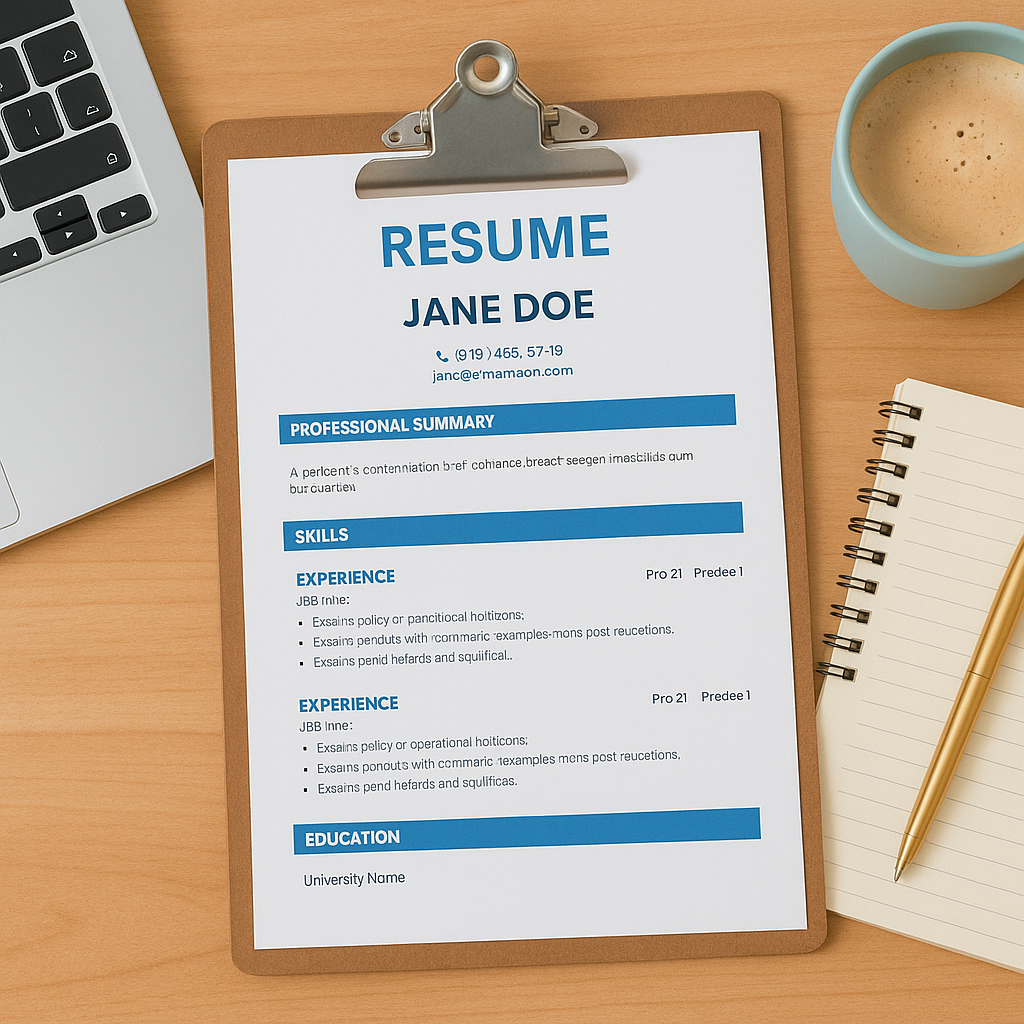
How to Create a Winning Internship Application Resume
Learn how to create a standout internship application resume with tailored sections, measurable achievements, and ATS-friendly tips to secure your dream role.
How to Craft an Impressive Internship Application Resume
Estimated reading time: 15 minutes
Key Takeaways
- Understand how an internship application resume differs from a general CV and why tailoring is crucial.
- Learn the essential sections: Contact Info, Objective, Education, Experience, Skills, and Additional Sections.
- Incorporate quantifiable results and keywords to engage recruiters and pass ATS filters.
- Avoid common mistakes like generic objectives and inconsistent formatting for stronger impact.
- Use available resources and strategies to customize your resume for each internship application effectively.
Introduction: Why Your Internship Application Resume Matters
An internship application resume is a targeted document that presents your qualifications, experiences, skills, and potential, specifically designed to secure internships. Unlike a general CV, an internship application resume is concise, tailored to a specific role, and calibrated to highlight your most relevant strengths for that opportunity.
In a competitive market where hundreds of students may apply to the same role, a well-structured, well-written internship application resume is often the decisive factor that gets you noticed and interviewed.
What sets a standout application apart is not just listing classes or clubs, but demonstrating fit, readiness, and results. Students often have fewer traditional jobs to show, so the emphasis shifts toward academic projects, coursework, campus leadership, volunteer roles, hackathons or case competitions, and transferable skills. When those elements are formatted cleanly, quantified when possible, and tailored to the posting, the impact is immediate.
This guide breaks down the intern-specific essentials—from the right sections to strategic tailoring—so you can create an internship application resume that is clear, credible, keyword-aligned, and built to impress both recruiters and applicant tracking systems (ATS).
Understanding the Components of an Internship Application Resume
Contact Information: Student Internship Resume Essentials
For a student internship resume, your contact details must be accurate, professional, and easy to read. This section should be at the top and require zero effort to understand.
Include:
- Full name (preferably in a larger font)
- Phone number (a number you’ll actually answer; set a professional voicemail)
- Email address (use a university or professional address; avoid nicknames)
- City and state (optional; helpful for local roles)
- LinkedIn profile (optional but recommended if complete and professional)
- Portfolio or GitHub (for technical/design roles, only if it’s relevant and polished)
Tips:
- Use a single phone number and a single email address.
- Ensure your LinkedIn headline and resume objective match thematically.
- Remove outdated or irrelevant links; broken links harm credibility.
- Avoid including your full mailing address to protect privacy unless requested.
Objective Statement: Clarify Goals on Your Internship Application Resume
An objective statement for an internship application resume is a concise two- to three-line summary of who you are, your target role, and what value you’ll deliver. Since most students have limited work experience, a strong objective helps contextualize your candidacy.
What to include:
- Your degree/major and expected graduation date
- Target internship function and industry
- 1–2 capabilities aligned with the role
- A value proposition (what the team gains by hiring you)
Example:
Objective: Data science student pursuing a Summer 2026 internship seeking to apply Python, SQL, and statistical modeling to real business problems. Experienced in building predictive models and communicating insights to non-technical audiences; excited to contribute to data-driven decision making.
Customize the objective for each role. Generic statements (“seeking to learn and grow”) are weak. Ground it in the internship description and mirror key phrases where appropriate.
Education: Strengthen Your Internship Application Resume
Your education section often carries the most weight on a student resume. Position it prominently below your objective if you’re still in school.
Include:
- Degree, major(s)/minor(s), institution
- Expected graduation month and year
- GPA (if strong: generally 3.5+ or per field norms)
- Relevant coursework (choose courses that align with the role)
- Academic honors (Dean’s List, scholarships, awards)
- Capstone or thesis title (if relevant)
Best practices:
- Emphasize coursework and projects that establish your fit for the role. For example, list “Data Structures and Algorithms” for software internships, “Corporate Finance” and “Financial Modeling” for finance internships, or “CAD and Materials Science” for mechanical engineering roles.
- Keep coursework selective: 4–8 classes that map to the job’s responsibilities and keywords.
- If including GPA, be consistent with formatting; consider major GPA if stronger and acceptable for your field.
Experience: Translate Work Into Impact on a Student Internship Resume
Experience on a student internship resume can include part-time jobs, research, project teams, co-ops, volunteer work, teaching assistantships, or relevant class projects. The key is relevance and results.
Structure each entry:
- Role or project title | Organization | Location | Dates
- 3–5 bullets using action verbs and metrics
Write high-impact bullets using the results-first mindset:
- Start with a strong verb (developed, analyzed, led, designed, optimized, implemented, facilitated).
- Specify tools, technologies, or methods (Python, Excel, Figma, SolidWorks, R, Tableau, CRM).
- Quantify outcomes (percent improvements, time saved, dollars earned/saved, users reached).
- Align with key competencies in the internship description (teamwork, problem-solving, customer service, research).
Examples:
- Built a Python-based ETL pipeline that automated weekly data ingestion, reducing manual effort by 6 hours/week and improving data accuracy by 18%.
- Led a 5-person case competition team; created a go-to-market plan projected to capture 3% market share in Year 1; presented findings to industry judges.
- Redesigned club website using responsive CSS frameworks; decreased bounce rate by 22% over 3 months and increased newsletter sign-ups by 150.
Skills: Build a Balanced Competency Mix for Your Internship Application Resume
A skills section should reflect both hard and soft skills, prioritizing specifics that match the job. Organize skills into categories to improve scannability and ATS alignment.
Consider grouping:
- Technical: Languages (Python, Java, SQL), Tools (Excel, R, Tableau, Power BI), Platforms (AWS, Azure), Design (Figma, Adobe XD), Engineering (SolidWorks, AutoCAD), Lab (PCR, Gel electrophoresis), Analytics (regression, hypothesis testing), QA/testing.
- Soft/Transferable: Communication, teamwork, leadership, stakeholder management, problem-solving, time management, adaptability, presentation skills, research, attention to detail.
Guidelines:
- Avoid listing soft skills without proof elsewhere. Reinforce them with bullets in Experience or Projects (e.g., “Presented findings to 60+ peers” demonstrates communication).
- Prioritize proficiency levels only when meaningful (e.g., “Advanced Excel: pivots, VLOOKUP/XLOOKUP, macros”).
- Mirror language from the job posting where accurate. ATS systems match exact phrases.
Additional Sections: Elevate a Student Internship Resume
These optional sections can differentiate your student internship resume:
- Projects: Feature 2–4 relevant class or independent projects with concise bullets showing outcomes, tools, and your role.
- Certifications: Industry-credible credentials (e.g., project management, cloud platforms, data analytics, CAD).
- Awards/Honors: Scholarships, competitions, dean’s list, research grants.
- Activities/Leadership: Clubs, student government, sports (with leadership roles and achievements).
- Languages: Include proficiency levels; relevant for global or customer-facing roles.
- Publications/Presentations: Posters, conference talks, or papers with titles and contexts.
Tips for Writing a Strong Student Internship Resume
Your student internship resume must turn academic work and campus involvement into evidence of job-readiness. The following tactics elevate your profile and make your internship application resume compelling and concise.
- Highlight high-value academics:
- Feature relevant courses that map to role responsibilities (e.g., Marketing Analytics, Machine Learning, Thermodynamics, Corporate Finance).
- Spotlight standout academic outcomes (e.g., “Top 5% in Algorithms,” “A in Financial Modeling”).
- Include capstone projects with an applied outcome (“Optimized a supply chain simulation reducing lead time by 12%”).
- Showcase projects with business or research impact:
- Use a Projects section to display tangible outputs, tools, and results:
- Data project: “Built a churn prediction model (AUC 0.88) using Python and scikit-learn; informed retention strategy.”
- Engineering design: “Prototyped a 3D-printed fixture, reducing assembly time by 30% in bench tests.”
- Marketing campaign: “Executed A/B tests on email subject lines; improved open rate from 18% to 27%.”
- Emphasize collaboration, methods, and user or stakeholder outcomes.
- Use a Projects section to display tangible outputs, tools, and results:
- Leverage extracurriculars and volunteer work:
- Link club roles to career skills (treasurer → budgeting; event chair → operations; hackathon participant → rapid prototyping).
- Quantify scope (“coordinated events for 200+ attendees,” “managed $8,500 budget”).
- Demonstrate initiative (“founded sustainability committee; launched recycling program across 4 residence halls”).
- Balance soft and technical skills:
- Pair soft skills with context:
- Communication: “Delivered weekly updates to non-technical sponsors; distilled insights into 5-slide briefs.”
- Teamwork: “Collaborated with 4 cross-functional teammates in Agile sprints.”
- Problem-solving: “Diagnosed root cause of data discrepancies; implemented validation scripts.”
- Cross-reference each claimed skill in your bullets to verify it in action.
- Pair soft skills with context:
- Use concise, high-impact formatting:
- One page is standard for an internship application resume; use clear section headings, consistent dates, and readable fonts.
- Prioritize bullets that show outcomes; remove filler (“responsible for,” “helped with”).
- Lead with the strongest accomplishments in each section.
- Keep margins and inherit space balanced for readability.
- Combine keywords strategically:
- Integrate both “internship application resume” and “student internship resume” logically in the summary or objective and throughout sections to reinforce relevance.
- Scan the internship description and incorporate exact phrases accurately (e.g., “stakeholder management,” “SQL,” “qualitative research,” “human-centered design”).
Common Mistakes to Avoid on Your Internship Application Resume
Avoiding common pitfalls ensures your internship application resume looks professional and passes quick recruiter scans and ATS rules.
- Typos and grammatical mistakes: Proofread carefully; read out loud; verify capitalization and punctuation consistency.
- Generic objectives: Vague statements without a target function or value add.
- Overlong resumes: Most students should fit everything on one page unless significant research or co-op experience warrants a second page.
- Dense paragraphs: Use bullets; avoid walls of text.
- Weak verbs and vague language: “Assisted with tasks” is far weaker than “Automated reconciliation in Excel, reducing cycle time by 35%.”
- No metrics: Even small numbers help (users supported, hours saved, percentage improvements).
- Misaligned skills: Listing tools irrelevant to the role or omitting those requested in the posting.
- Inconsistent formatting: Date formats, dash styles, bullet indentation, and font sizes must be uniform.
- Unnecessary personal details: Photos, full address, birthdate, or unrelated social media.
- Misjudged GPA strategy: Include GPA if it helps; omit or move to the bottom if below threshold norms and not required.
- Keyword stuffing: ATS-friendly does not mean repeating keywords without context; incorporate them meaningfully in bullets and projects.
- Confidential information: Don’t disclose proprietary data; focus on outcomes and your contribution.
- Unprofessional file names: Save as FirstLast_Resume.pdf; use PDF unless the employer requests a different format.
Quality control checklist:
- Print preview: Does it look clean at 100% zoom and on mobile?
- Skim test: Can someone glean your major, target role, key skills, and top achievements in 10 seconds?
- Consistency check: Tenses (past for completed roles, present for ongoing), spacing, punctuation.
- Peer review: Ask a classmate or mentor to spot unclear areas or missing metrics.
Customization: Tailoring Your Student Internship Resume for Different Internships
Targeted customization transforms a generic student internship resume into a standout application. Tailoring does not mean rewriting from scratch; it means refining emphasis, ordering, and keywords.
- Research the employer:
- Study the internship description and note repeated phrases or core competencies.
- Review the company’s values, products, and recent initiatives to mirror relevant themes (innovation, customer-centricity, sustainability, data-driven decision making).
- Identify the team’s likely challenges and align your examples accordingly.
- Adjust content for each role:
- Objective or summary: Update target role, industry, and value proposition using keywords from the posting.
- Reorder bullets: Put the most relevant accomplishments first under each role or project.
- Emphasize aligned projects: Move the most relevant projects higher or expand their bullets with skills the posting emphasizes.
- Swap coursework: Feature classes that directly match the internship requirements.
- Skills tuning: Prioritize skills in the same language as the posting (e.g., “SQL” rather than “databases,” “qualitative interviews” rather than “user research” if that’s the phrasing used).
- Optimize for ATS:
- Use standard section headers (Education, Experience, Skills, Projects).
- Avoid text boxes or complex formatting that may confuse parsers.
- Include exact-match keywords accurately reflected in your experience.
- Use simple bullets and consistent dates in Month YYYY format.
- Maintain a master resume:
- Keep a longer master document with all roles, projects, and bullets.
- For each application, create a tailored version by selecting the most relevant elements.
- Update your master regularly to capture new metrics and achievements.
- Signal professionalism end-to-end:
- Match your resume content with your cover letter’s emphasis.
- Ensure your LinkedIn profile mirrors your tailored narrative.
- Set file naming conventions and email subject lines that look polished.
Examples of Effective Internship Application Resumes
Below are structured examples to show how a strong internship application resume can look in different fields. Adapt the language, tools, and metrics to your experience.
Example 1: Software Engineering Internship Application Resume
Objective
Computer Science student (BS, Expected May 2027) seeking a Summer Software Engineering Internship to apply Java, Python, and data structures in building scalable backend services; passionate about writing clean, tested code and collaborating in Agile teams.
Education
- BS, Computer Science, University Name, Expected May 2027
- Relevant Coursework: Data Structures & Algorithms, Operating Systems, Databases, Computer Networks
- GPA: 3.7/4.0; Dean’s List (3 semesters)
Projects
- Task Tracker Web App | React, Node.js, MongoDB
- Built RESTful APIs supporting CRUD operations; reduced average response time by 35% through query optimization.
- Implemented JWT authentication and role-based access; improved security and user session reliability.
- Algorithm Visualizer | Python
- Created interactive sorting and graph traversal visualizations; packaged as a CLI tool and achieved 500+ downloads.
Experience
- Teaching Assistant, Data Structures | University
- Led weekly labs for 25 students; clarified complexity analysis and pointer management; student pass rates improved by 12%.
- Wrote automated unit tests for starter code; reduced debugging time by 40% across sections.
Skills
- Languages: Java, Python, JavaScript, SQL
- Frameworks/Tools: React, Node.js, Express, Git, Docker, Postman
- Concepts: OOP, REST, unit testing, Agile/Scrum
- Soft Skills: Collaboration, communication, problem-solving
Example 2: Marketing/Business Student Internship Resume
Objective
Marketing major (BA, Expected Dec 2026) seeking a Summer Brand Marketing Internship to apply consumer research, content strategy, and analytics; experienced in A/B testing and campaign reporting with a focus on measurable growth.
Education
- BA, Marketing, University Name, Expected Dec 2026
- Relevant Coursework: Consumer Behavior, Marketing Analytics, Digital Strategy, Brand Management
- Honors: Scholarship Recipient; Case Competition Finalist
Projects
- Social Media Growth Plan | Student Consulting Club
- Developed 90-day content calendar; grew follower base by 28% and improved engagement rate from 2.1% to 4.5%.
- Ran A/B tests on creative and copy; identified top-performing posts, increasing click-through by 19%.
- Market Sizing Analysis | Course Project
- Estimated TAM/SAM/SOM for a direct-to-consumer product; built a bottom-up forecast and a 3-year P&L model.
Experience
- Sales Associate | Retail Brand
- Exceeded monthly sales targets by 15% average; upsold accessories, increasing average transaction value by 12%.
- Collected customer feedback; prepared weekly summaries informing merchandising adjustments.
Skills
- Tools: Excel (pivots, XLOOKUP), Google Analytics equivalents, basic SQL
- Creative: Copywriting, content planning, basic Photoshop/Canva
- Soft Skills: Customer service, presentation, stakeholder management
Example 3: Engineering/Operations Internship Application Resume
Objective
Mechanical Engineering student (BS, Expected May 2027) seeking a Manufacturing/Operations Internship to apply CAD, GD&T, and lean methodologies; interested in process optimization and quality improvement.
Education
- BS, Mechanical Engineering, University Name, Expected May 2027
- Relevant Coursework: Statics, Dynamics, Thermodynamics, Materials Science, CAD/CAM
- GPA: 3.6/4.0
Projects
- Fixture Design for Assembly Line | SolidWorks
- Designed and prototyped a 3D-printed fixture reducing assembly time by 30% in pilot tests; incorporated ergonomic improvements.
- Created detailed engineering drawings with GD&T; collaborated with machine shop for rapid iteration.
- Heat Exchanger Simulation | MATLAB
- Modeled heat transfer rates; validated results with lab data within 5% error; recommended design tweaks for efficiency gains.
Experience
- Operations Intern | Campus Dining
- Mapped kitchen workflows; proposed layout adjustments cutting average order prep time by 18%.
- Implemented a basic Kanban system for inventory; reduced stockouts by 25%.
Skills
- Tools: SolidWorks, AutoCAD, MATLAB, Excel (Solver)
- Methods: Lean, 5S, root cause analysis, SPC
- Soft Skills: Teamwork, continuous improvement mindset, documentation
Example 4: Research/Lab Student Internship Resume
Objective
Biology major (BS, Expected May 2026) seeking a Research Internship to utilize PCR, gel electrophoresis, and data analysis; interested in molecular biology and lab standard operating procedures.
Education
- BS, Biology, University Name, Expected May 2026
- Relevant Coursework: Molecular Biology, Biochemistry, Genetics, Statistics
- Honors: Dean’s List (4 semesters)
Projects
- Gene Expression Study | Course Project
- Conducted PCR to amplify target sequences; ran gels and analyzed bands; documented protocols and results.
- Performed statistical analysis in R; identified significant expression differences (p < 0.05) across conditions.
Experience
- Lab Assistant | Department of Biology
- Prepared reagents, maintained equipment logs, and ensured compliance with lab safety protocols.
- Organized sample inventory; improved retrieval time by 40% through a standardized labeling system.
Skills
- Lab: PCR, gel electrophoresis, spectrophotometry, pipetting, sterile technique
- Data: R, Excel, basic visualization
- Soft Skills: Attention to detail, documentation, teamwork
Additional Resources for Student Internship Resume Success
While you won’t rely on external references here, consider the categories of tools and support that can sharpen a student internship resume and accelerate your internship search:
- Resume-building and optimization tools (general categories):
- Template builders: Clean, ATS-friendly formats that use clear headings and standard fonts.
- Grammar and clarity checkers: Catch typos, verbose phrasing, and tone issues.
- ATS keyword scanners: Identify missing or underemphasized keywords relative to a posting.
- PDF validators: Ensure your exported file preserves formatting and is selectable (not an image).
- Campus and community resources:
- University career centers: One-on-one resume reviews, mock interviews, and industry-focused workshops.
- Faculty advisors and TAs: Technical feedback on project descriptions, research framing, and domain terminology.
- Peer review circles: Trade resumes with classmates in your major; annotate each other’s bullets and quantify results.
- Alumni networks: Request informational conversations; gather insights about what specific employers value on a student internship resume.
- Student clubs and competitions: Case competitions, hackathons, engineering design teams—these generate measurable achievements for your resume.
- Career fairs and employer info sessions: Learn role expectations; adjust your internship application resume based on direct recruiter feedback.
- Mentorship programs: Pair with an industry mentor who can review and help tailor your resume for niche roles.
- Self-assessment and tracking systems:
- Master resume repository: Maintain a document with all experiences, projects, and detailed bullets; tailor per application from this base.
- Achievement log: A running list of metrics, outcomes, and tools used so you can quantify results later.
- Application tracker: Record each submission, tailored keywords used, contacts made, and follow-up dates.
- Practical exercises to sharpen your resume:
- Quantification challenge: Revisit 10 bullets and add metrics or scope for each (users, dollars, hours, percentages).
- Keyword calibration: Extract 10 keywords from a target posting; integrate them meaningfully into your objective, skills, and bullets.
- Ten-second test: Ask a friend to skim your resume for 10 seconds and then describe your target role, top skills, and biggest achievement; iterate based on gaps.
Conclusion: Final Thoughts on Your Internship Application Resume
A strong internship application resume is more than a list of classes and activities. It is a focused argument for your readiness: evidence that you can learn quickly, contribute immediately, and communicate clearly. By structuring your document around the essential sections, leading with quantifiable achievements, and tailoring for each role, you transform a basic student internship resume into a persuasive, ATS-friendly profile.
To recap:
- Define your objective with precision and align it to the role.
- Elevate Education with targeted coursework and standout projects.
- Turn experiences—class, club, research, or work—into measurable impact.
- Balance technical and soft skills backed by evidence.
- Avoid common mistakes with rigorous proofreading and formatting discipline.
- Customize for each posting using role-specific keywords and reordered emphasis.
- Leverage campus resources and feedback loops to keep iterating.
Take action now: choose one target internship, extract its keywords, and revise your internship application resume to highlight the 4–6 most relevant capabilities. Then ask a peer, mentor, or advisor to review it against the posting. Iteration wins interviews. Your next opportunity may hinge on the clarity and credibility of this single page—make it count.
FAQ
- What is the difference between a CV and an internship application resume?
- An internship application resume is shorter, targeted to specific roles, and highlights relevant skills and projects, whereas a CV is often longer and comprehensive, including all academic and work history.
- How long should my internship application resume be?
- Typically, one page is standard for student internship resumes unless you have extensive relevant experience. Conciseness and relevance are key.
- Should I include a GPA on my internship resume?
- Include your GPA if it is strong (generally 3.5+). If your major GPA is stronger and accepted, consider listing that. Otherwise, omit it.
- Can I use the same resume for all internship applications?
- It’s best to tailor your resume to each internship by emphasizing relevant skills and keywords to maximize impact and ATS compatibility.
- How do I make my resume ATS-friendly?
- Use simple, standard section headers like Education, Experience, Skills; avoid graphics, columns, and complex formatting; and include keywords exactly as they appear in the job posting.